
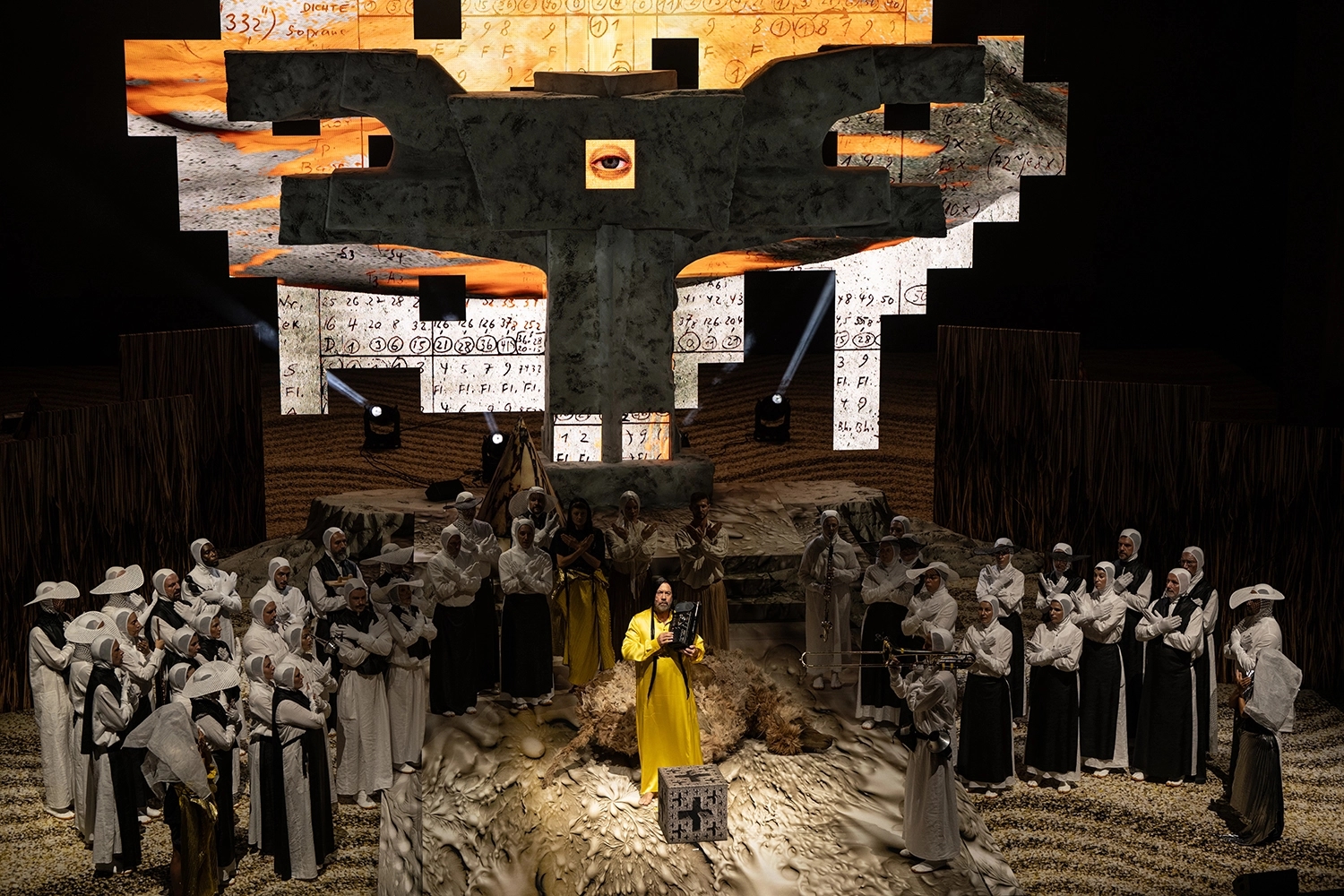
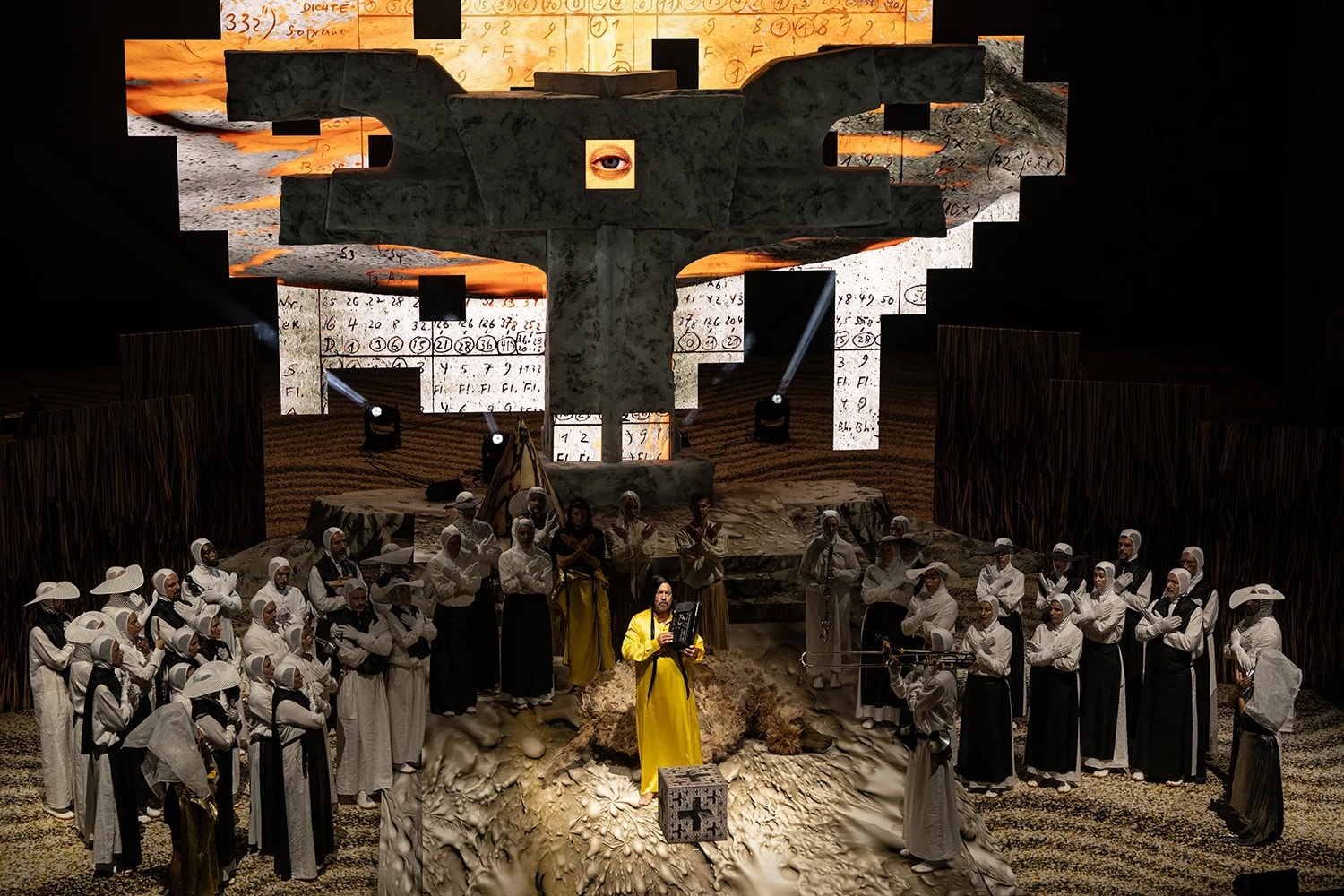
From 19 to 27 September 2026, Deutsche Oper Berlin presented five performances of Mittwoch aus Licht, the final chapter in Le Balcon’s exploration of Karlheinz Stockhausen’s seven-opera cycle Licht, initiated in 2018.
Conducted by Maxime Pascal, with stage direction by Susanne Kennedy and set design by Markus Selg, the production marked the first staged presentation of the opera in the German-speaking world.
To realise Stockhausen’s spatial score, Le Balcon collaborated with Deutsche Oper Berlin to develop an extensive spatial sound system comprising 59 Amadeus loudspeakers, complemented by six d&b subwoofers from the house inventory, and a HOLOPHONIX Ultra spatial audio processor supplied by Le Balcon.
Bringing the sound image back to the stage
At the heart of the system, two lines of Amadeus loudspeakers operate in Wave Field Synthesis (WFS) through HOLOPHONIX, allowing sound sources to be localised according to their positions on stage.
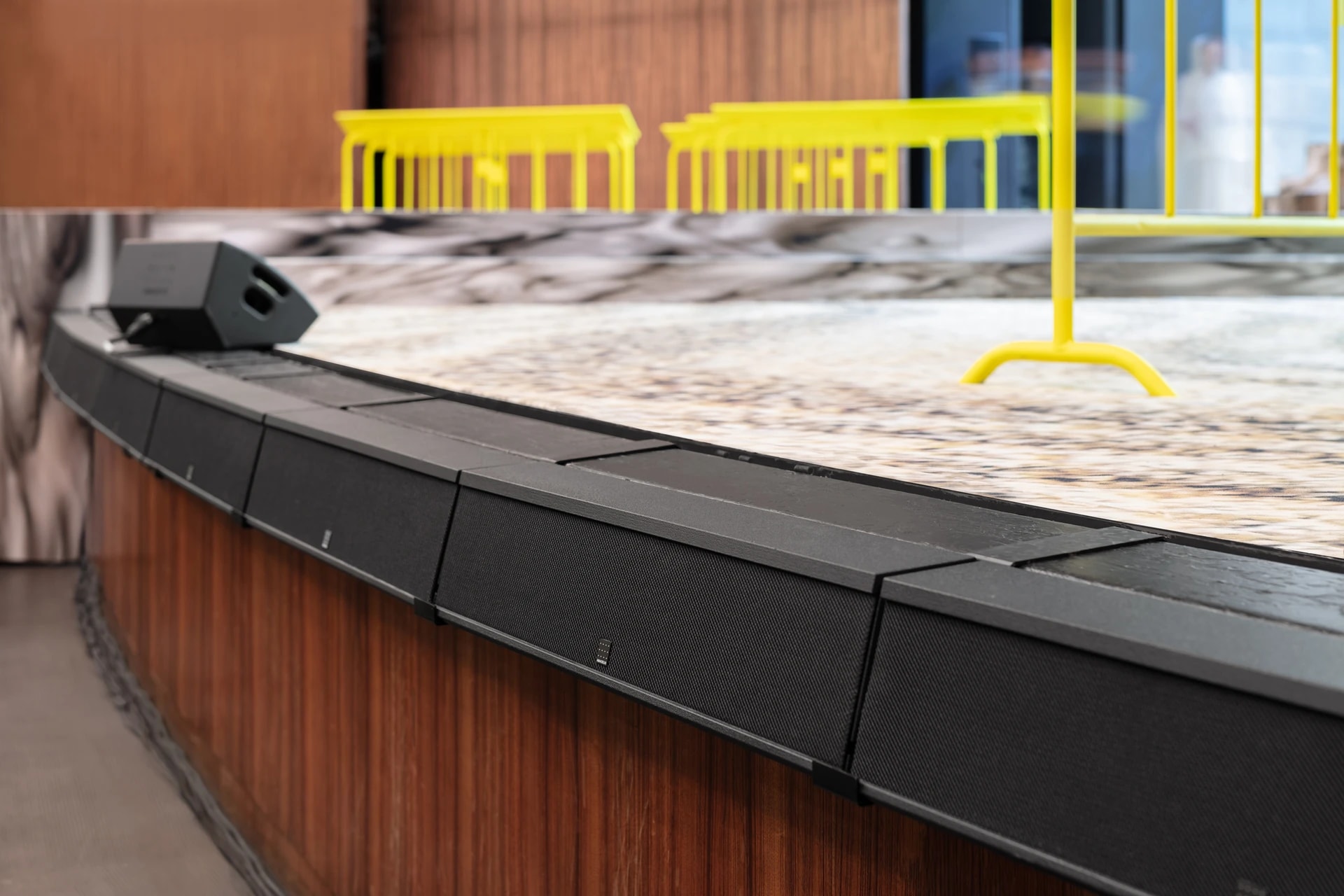
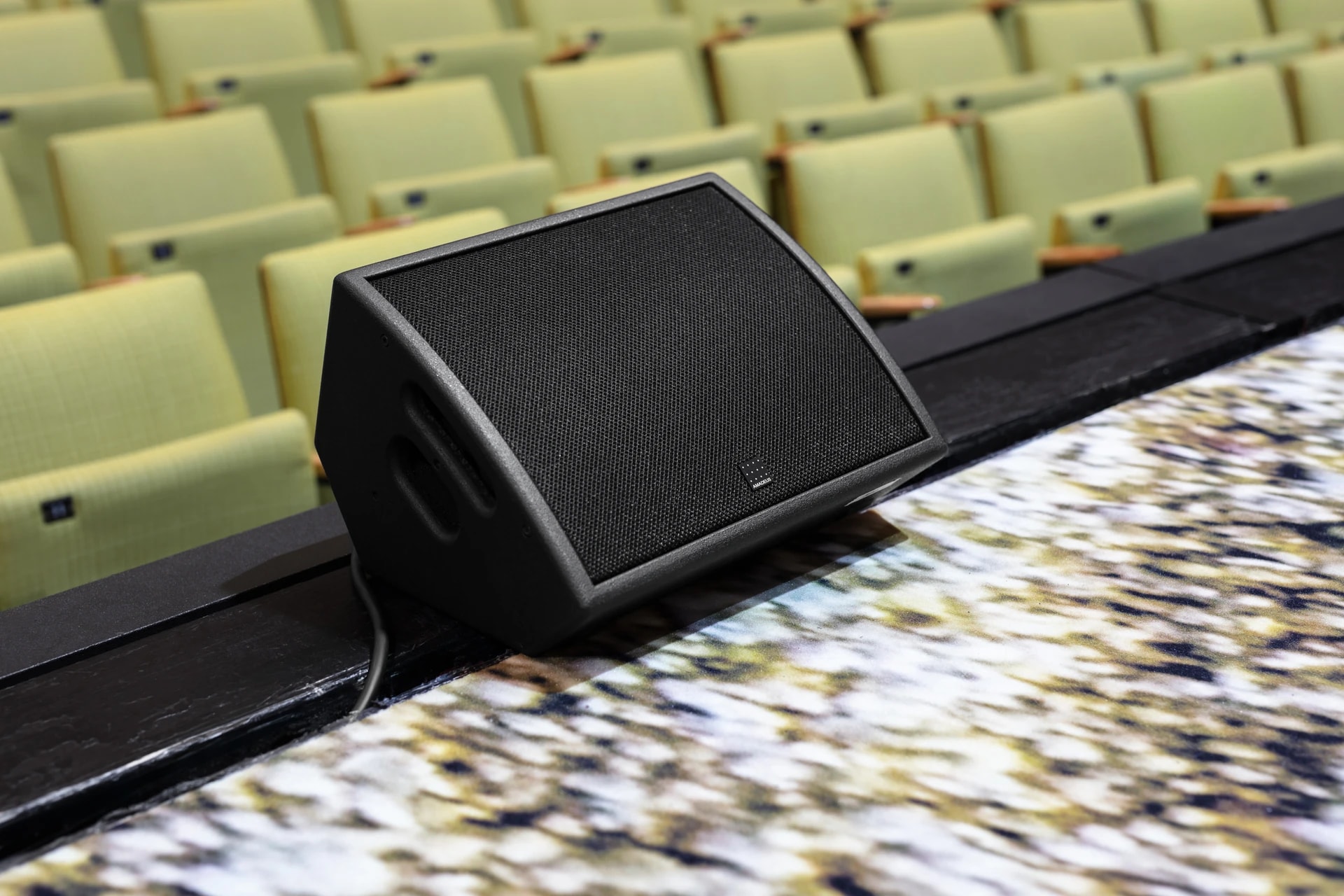
The lower line consists of 23 custom-designed Amadeus SR 790 modules installed along the front edge of the stage. Developed specifically for the production, their front baffles follow the 17° rake of the auditorium seating, a configuration unprecedented at Deutsche Oper Berlin.
Above the stage, a second line of eleven Amadeus C 15-90 loudspeakers extends coverage to the balconies.
Together, the two arrays aim to maintain a coherent sound image throughout the auditorium, from the front rows to the upper seating areas.
The challenge is to ensure that, for every seat, the sound image appears to come from the stage without seeming too high,
explains Florent Derex, co-founder of Le Balcon and sound engineer for the production.
Beyond the frontal arrays, six Amadeus C 12-80 loudspeakers cover the sides and rear of the stalls, four C 8 R units serve the rear balconies, and four ceiling-mounted C 10 loudspeakers introduce a vertical dimension.
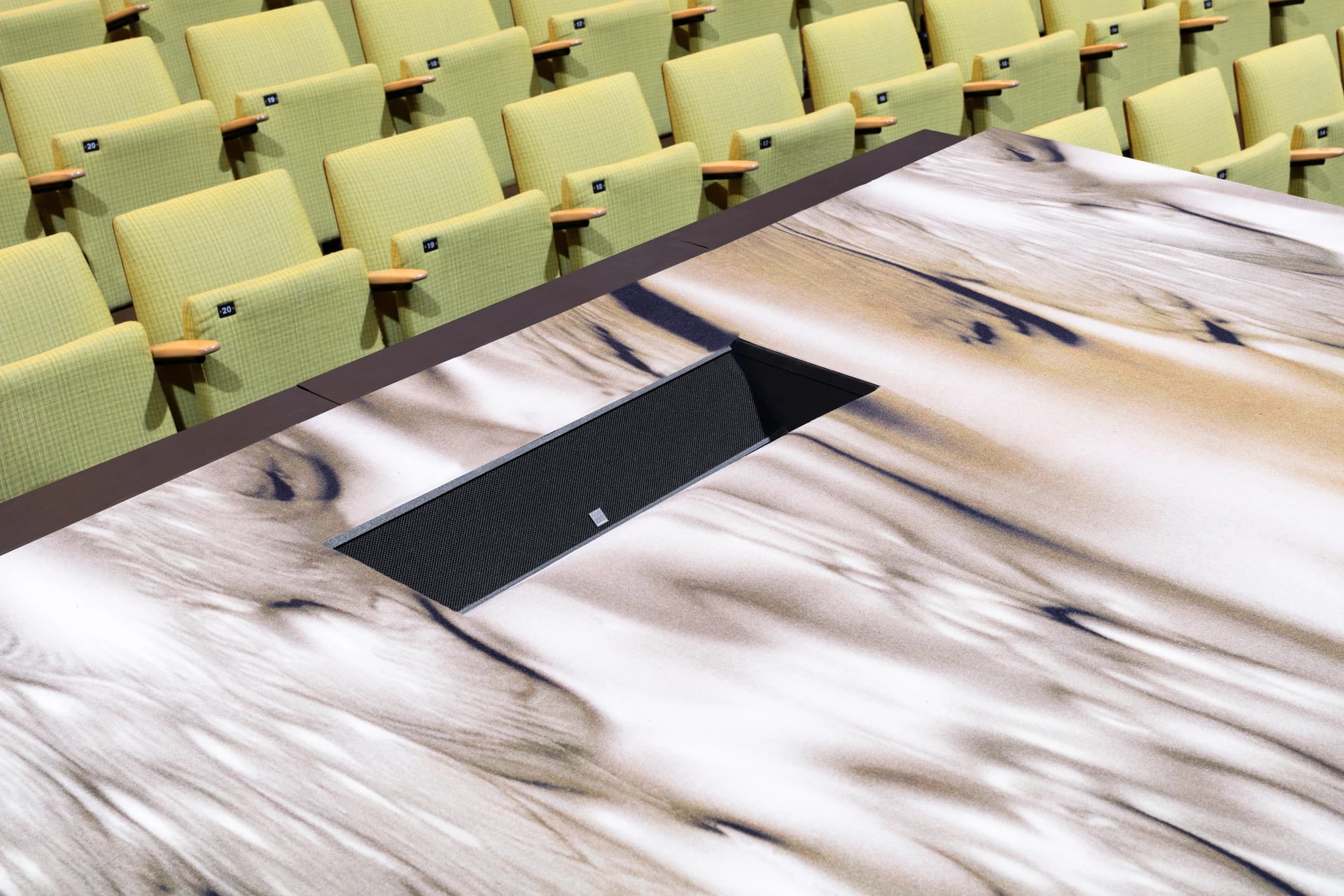
On stage, an additional SR 790 module was recessed into the floor, complemented by eight C 8 R monitors and two C 4 loudspeakers dedicated to the synthesisers.
This configuration supports both the precise localisation of performers and the more enveloping electronic soundscapes required by Stockhausen’s score.
Spatialisation as a tool of musical interpretation
Different musical materials require different approaches to spatialisation.
Within HOLOPHONIX, Florent Derex primarily uses WFS to anchor voices and instruments to their positions on stage, alongside k-nearest neighbors (KNN) for selected sound trajectories. Direct to Master allows signals requiring no spatial processing to pass through the system while maintaining consistent latency.
For the electronic elements, IRCAM computer music designer Augustin Muller works with Layer Based Amplitude Panning (LBAP) and Higher Order Ambisonics (HOA), adapting the spatial rendering to each musical passage.
It’s an expressive tool. I use three panning buses: a very precise Layer Based Amplitude Panning bus for the octophonic material, a second, more diffuse Layer Based Amplitude Panning bus, and a Higher Order Ambisonics bus for the Michaelion scene,
Muller explains.
The distinction is central to the interpretation of the work. While instrumental sources often require precise localisation, electronic textures can move more freely through the auditorium, creating a continuously evolving sound environment.
Four helicopters, sixteen microphones
One of the most remarkable moments of Mittwoch aus Licht is the Helikopter-Streichquartett, in which each member of a string quartet performs aboard a separate helicopter.
For the Berlin production, the sequence was captured at Schönhagen airfield during a public event broadcast live, before being incorporated into the staged performances as a video projection.
Each helicopter carried four microphones, capturing the instrument, the musician’s voice and the sound of the rotor. Sixteen audio signals were transmitted from the four aircraft, with a click track maintaining synchronisation between the musicians.
In Stockhausen’s composition, the helicopter rotors are themselves musical elements, their rotational speeds and resulting pitches contributing directly to the score.
When you see it live, you realise they’re synchronised: they’re playing together, but in space, while flying,
recalls Derex.
For the opera performances, Augustin Muller spatialised the helicopter soundtrack using Higher Order Ambisonics, creating the impression of aircraft moving around the audience while the musicians appeared in flight on screen.
An exceptional production in a repertory opera house
Integrating such an extensive system into Deutsche Oper Berlin presented significant logistical challenges.
Unlike a venue dedicated to a single production, Deutsche Oper maintains a repertory of approximately 40 productions, with several performances sharing the same stage during the Stockhausen run.
Everything had to be capable of being dismantled and reassembled, and we had to be ready to stage a performance within two or three hours,
explains Andreas Gockel, Head of Sound at Deutsche Oper Berlin.
The installation required a team of eight or nine technicians, compared with the two or three typically needed for a performance.
Preparation began well before the production. Amadeus supplied nine Powersoft Ottocanali amplifiers, providing 72 Dante-networked amplification channels, preconfigured in Paris with Francesco Papaleo, Application Engineer at HOLOPHONIX.
The Amadeus teams also supported the on-site installation and system alignment, while Le Balcon carried out a complete system test before shipment to Berlin.
Extending the musical space
Following Montag aus Licht at the Philharmonie de Paris, Mittwoch aus Licht represents another milestone in the longstanding collaboration between Le Balcon, HOLOPHONIX and Amadeus.
At Deutsche Oper Berlin, the combination of WFS, KNN, LBAP and HOA made it possible to translate Stockhausen’s spatial writing into a complex, three-dimensional listening experience.
Rather than serving as an effect, spatialisation became part of the musical interpretation itself, bringing voices, instruments, electronics and helicopters into a shared sound world extending far beyond the physical boundaries of the stage.
Crédits photos — © Julian Roeder, © Helen Karam