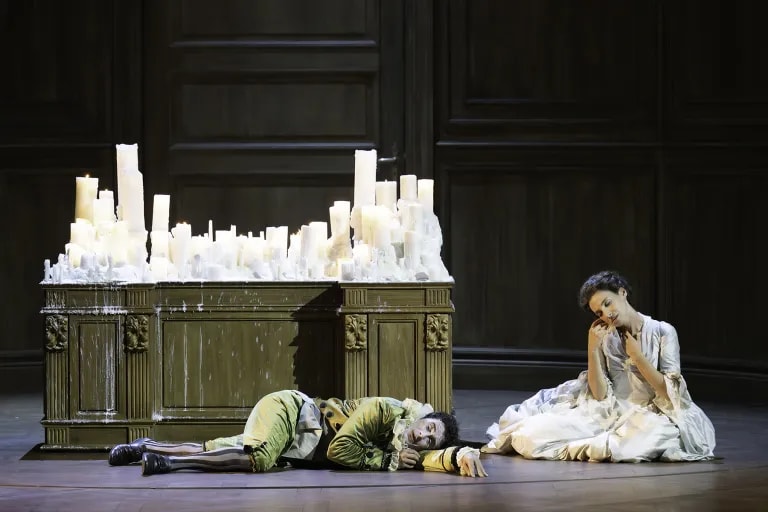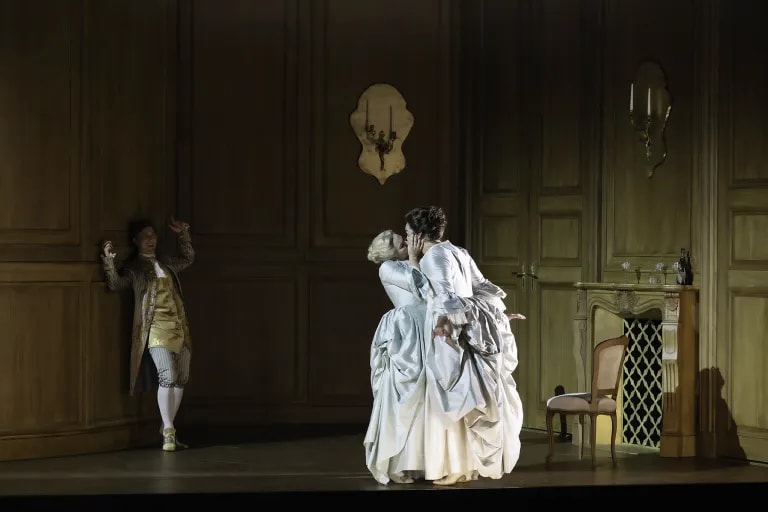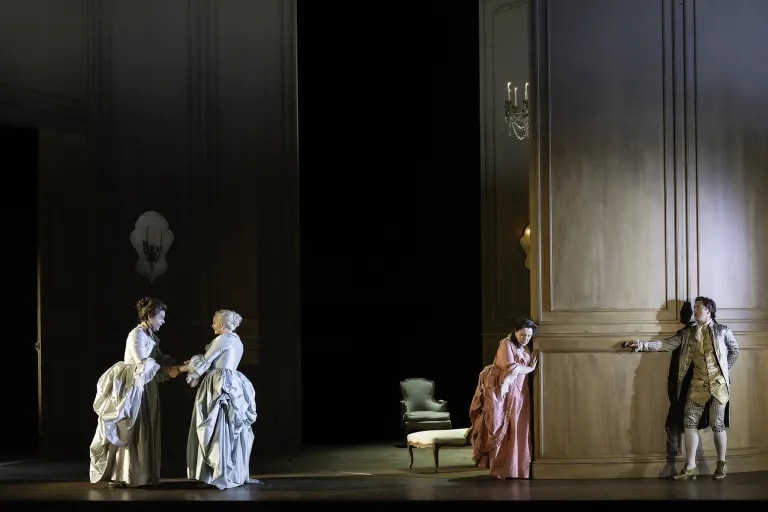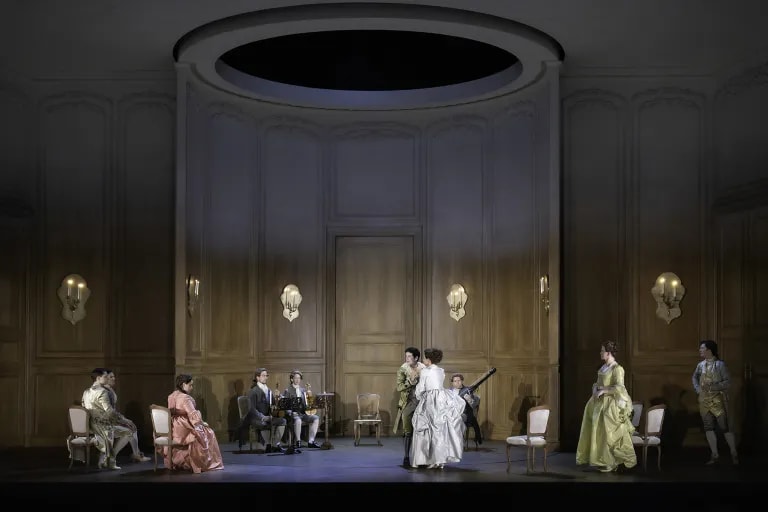
At the heart of the Festival d’Aix-en-Provence, Francesco Cavalli’s La Calisto found new life at the Théâtre de l’Archevêché. Staged by Jetske Mijnssen and conducted by Sébastien Daucé, this reimagining of the baroque repertoire unfolded within a singular scenic space, carried by an acoustic approach of remarkable refinement.
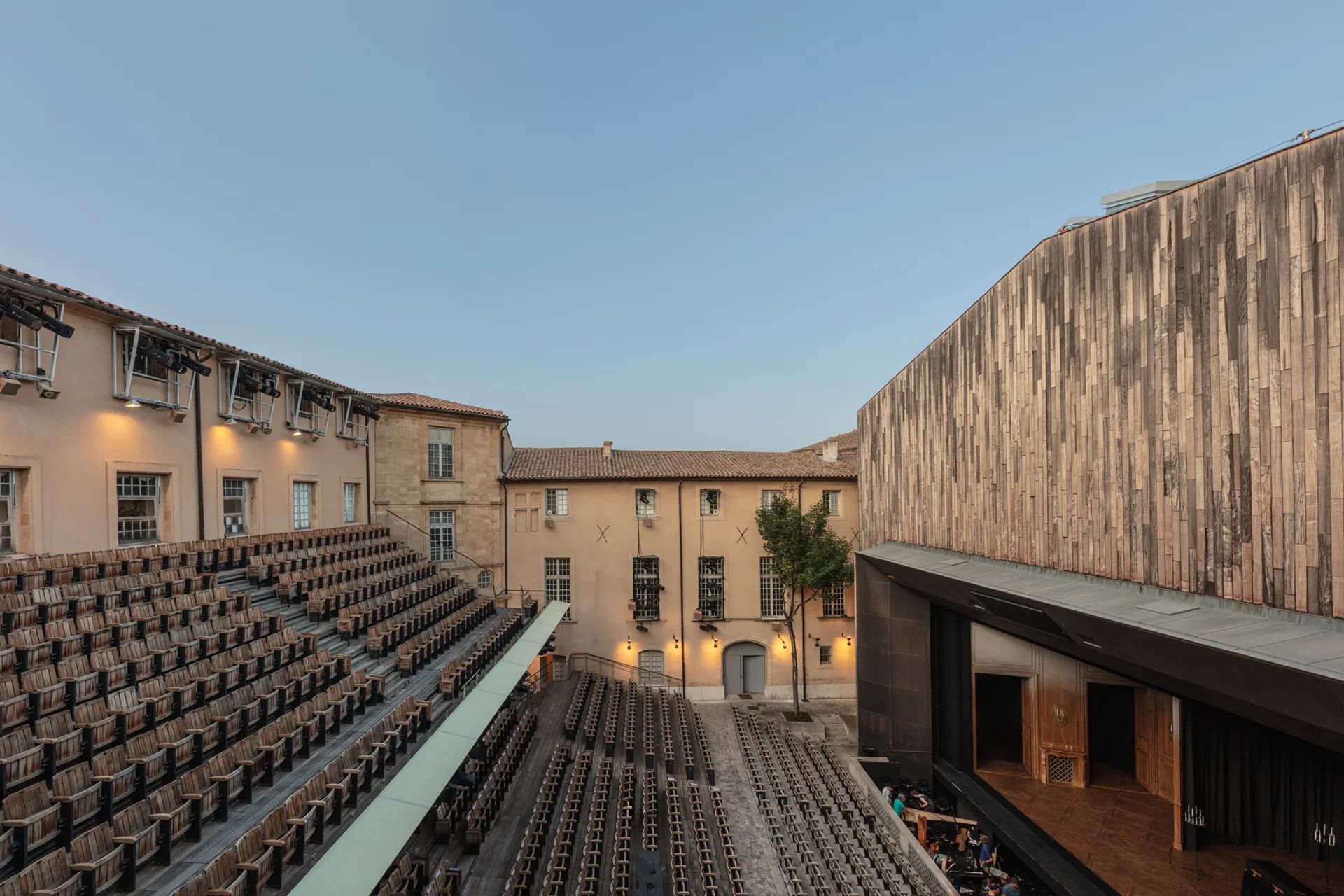
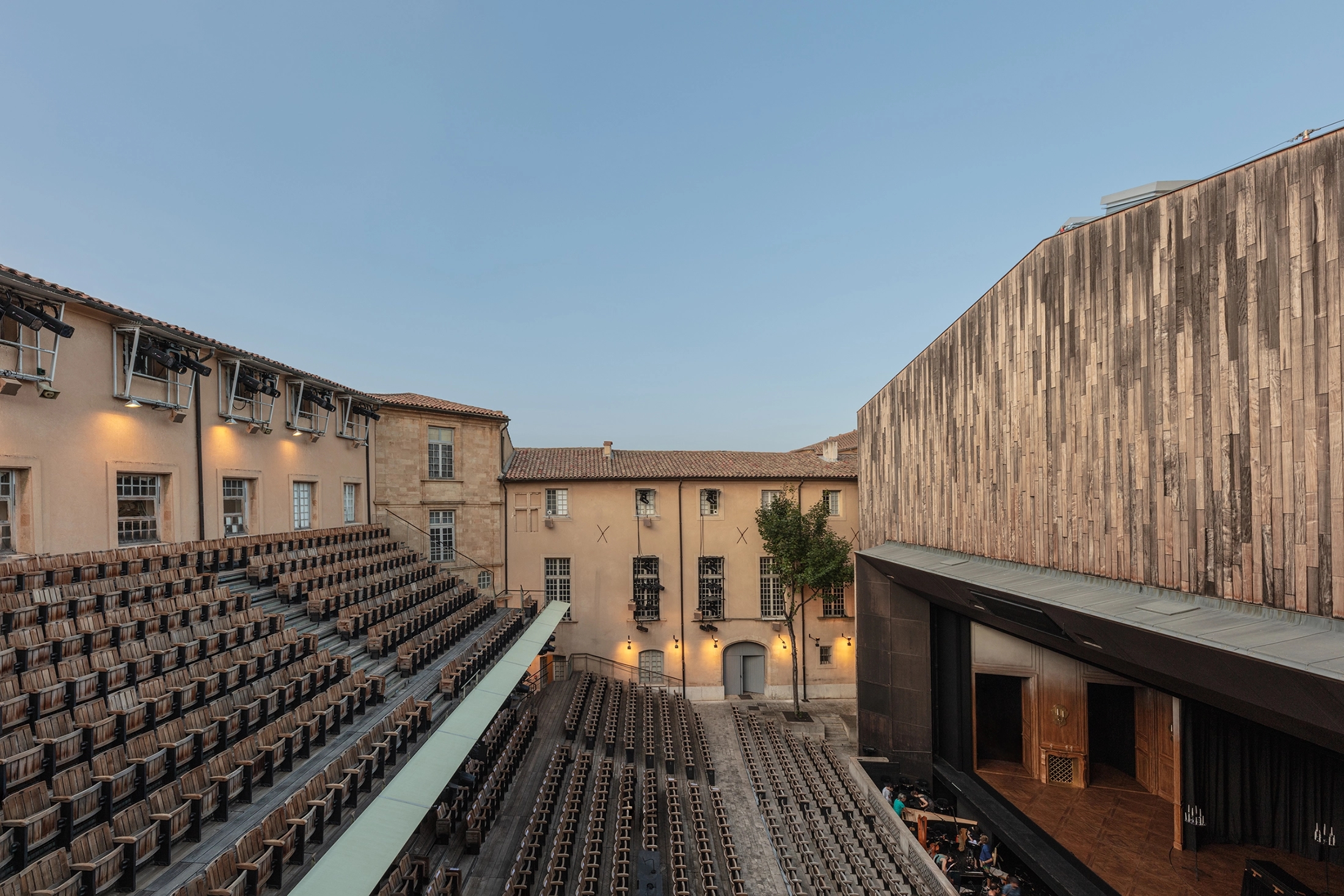
The Théâtre de l’Archevêché offers an acoustic environment with little natural resonance and highly variable absorption zones: an open parterre, a balcony overhang with a dampened response, and an upper balcony more isolated from direct sources. This heterogeneity makes it particularly challenging to achieve a balanced sound diffusion, all the more delicate for a work as finely poised as La Calisto.
The request from conductor Sébastien Daucé and the artistic teams was clear: to acoustically support the opera without ever revealing the presence of amplification, bringing warmth, clarity, and breadth, while keeping the tool invisible.
We formed a tailor-made technical trio around the intentions of Sébastien Daucé : Pidou on mixing, Alban Moraud on recording, and myself on the implementation and tuning of the HOLOPHONIX system. This constant dialogue between artistic gesture and sound architecture enabled a living, evolving approach, always in the service of the music,
explains Félix Perdreau, sound engineer and spatialization specialist in charge of deploying the system.
Amadeus thus designed an immersive electroacoustic system, seamlessly integrated, combining visual discretion with sonic precision. Nearly fifty loudspeakers were deployed, many custom-built for this production.
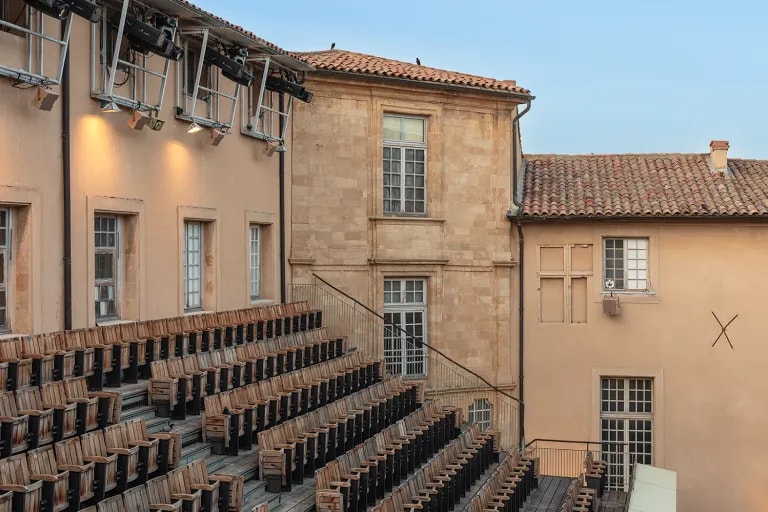
All surround speakers were specially manufactured and coated with a mineral finish developed by the Amadeus workshops, a blend of pigments, natural stone powder, and acrylic binder, making them virtually invisible within the theatre’s historic architecture.
A frontal ramp of fourteen modules, named SR 1000 (for Sound Ramp 1000 mm), also custom-designed, was embedded flush with the stage. Each module houses two coaxial 5-inch transducers derived from the PMX 5, precisely angled to cover the lateral and lower audience areas.
The system also included two C 15 and two PMX 5 for the lower front, two C 12 for the upper front, two C 6as outfill, eight PMX 4 to cover the under-balcony area, twelve C 12 for lateral surrounds, and seven C 6 for rear upper surrounds.
Each listening area — parterre, under-balcony, balcony — was addressed with targeted acoustic treatment, designed to provide tonal and dynamic coherence across the 1,352 seats of the Archevêché, without ever weighing down the listening experience.
The project was developed in close collaboration with HOLOPHONIX, responsible for sound spatialization and active reverberation. Thanks to WFS bus management, a software reverb engine, and real-time control via OSC and Open Stage Control, different performance zones — recitatives, choruses, ensembles — could be adjusted dynamically, with great finesse.
In the end, despite initial hesitations about the fear of “audible” amplification, the system proved itself through its very sonic invisibility. A direct comparison with another opera performed in the same venue without any reinforcement revealed just how subtly the addition of a virtual acoustic environment could enrich listening without adding weight.
The real luxury was to offer imperceptible support, ensuring the same quality of listening from every seat, for an audience of more than 1,300 in the open air. When nobody notices the system, that’s when it’s working,
says Félix Perdreau.
For Amadeus, this production marks a new milestone in the integration of immersive technologies in the service of the classical repertoire. When the system disappears, the music takes its rightful place.
As often, technical limitations inspire the next steps: an additional upper ramp would have given us more freedom with vertical balances, and a few more surround speakers under the balcony would have reinforced the immersive unity of the whole. These ideas are already pointing toward future evolutions,
concludes Félix Perdreau.