
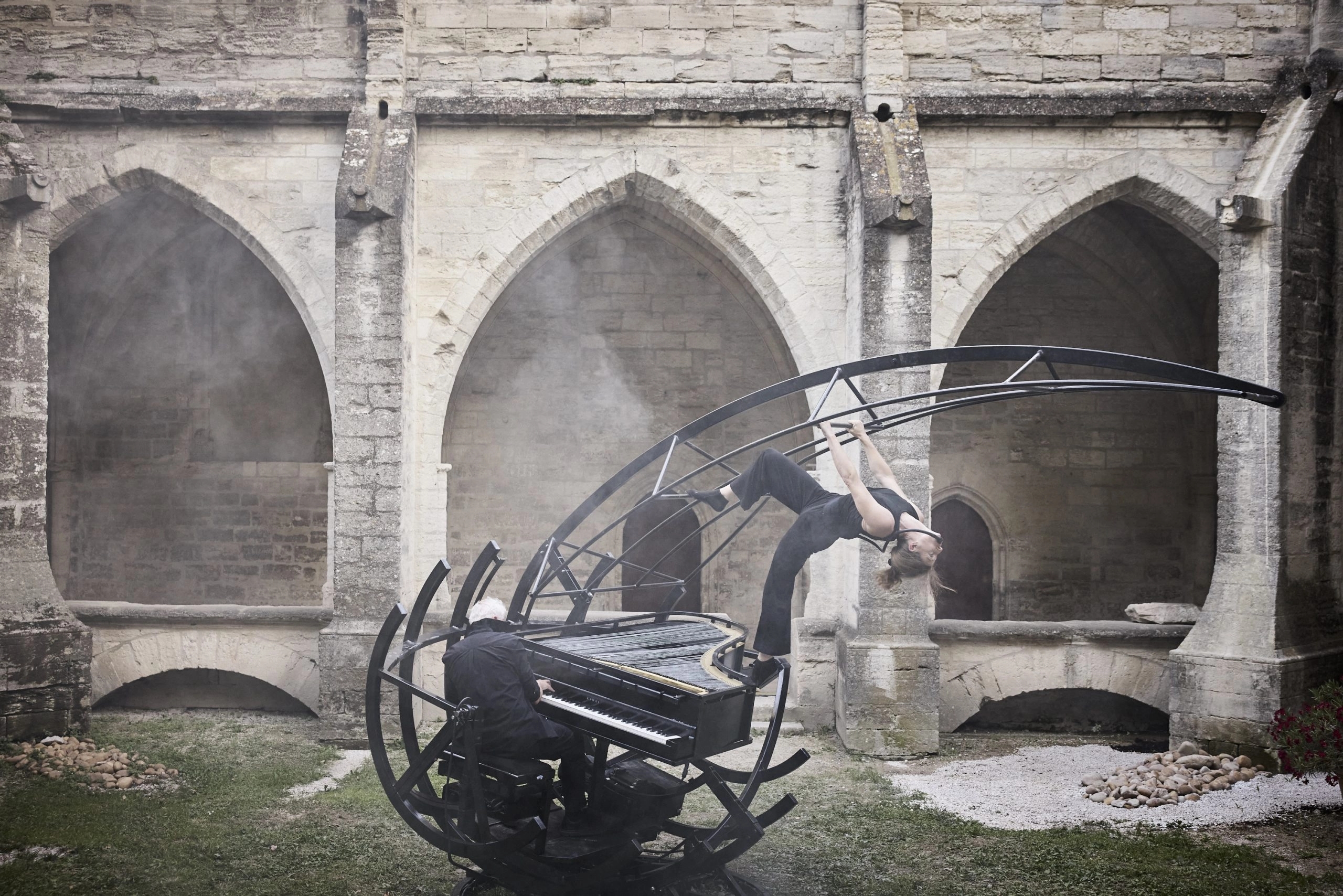
Aerial artist, choreographer and founder of Compagnie Happés, Mélissa Von Vépy has spent more than twenty years developing a theatrical language in which structures, apparatus and objects play an integral role in the dramaturgy. For Piano Rubato, created with pianist and composer Stéphan Oliva, she conceived a work in which a piano becomes a moving sculpture.
At first glance, the piano seems to have shed its familiar form. All that remains is its framework, extended by an immense metallic sail that traces the silhouette of a ship. The structure comes to life through Mélissa Von Vépy's breath, while Stéphan Oliva's improvisations accompany each of its movements. Together, they create a journey in which music, movement and scenography evolve as one.
For this production, Amadeus developed a bespoke electroacoustic system designed to reproduce the acoustic qualities of the piano within this unconventional scenography.
A piano transformed into a living sculpture
The title of the piece refers to the Italian musical term rubato, which describes the rhythmic freedom afforded to a performer. This principle runs throughout the work. Mélissa Von Vépy's gestures, Stéphan Oliva's improvisations and the movements of the structure follow the same breath, giving the performance its rhythm and fluidity.
Designed with scenographer Neil Price, the piano-boat lies at the heart of the performance. Its lid, extended to a height of almost five metres, is connected to a counterweight system activated by Mélissa Von Vépy's breathing. With each inhalation and exhalation, the structure oscillates, accompanying the artist as she moves around and above the piano.
Inspired by maritime myths and tales of passage, the work transforms the piano into a vessel for a poetic journey.
As Mélissa Von Vépy explains:
Here, the piano has become a vessel, a ship. An extrapolation of its intrinsic potential: music moves us, inwardly. This is why we conceived the performance as a journey across the open sea, sometimes calm, sometimes turbulent, on the surface or in the depths.
Designing an electroacoustic system for a moving sculpture
The mobility of the structure called for a specific approach to sound reinforcement. The challenge was not simply to integrate loudspeakers into the piano, but to reconstruct an extended sound source capable of reproducing the acoustic behaviour of a concert piano while moving with the instrument on stage.
Numa Galipot, acoustic engineer at Amadeus and responsible for the project's R&D development, explains:
The soundboard of a concert piano radiates in every direction across almost two square metres of vibrating surface, and its directivity changes with frequency: it is an extended source, not a point source. No single loudspeaker can reproduce that. We therefore distributed three sources throughout the structure, which immediately raises the question of how they combine. Depending on the frequency and the listener's position in the auditorium, they can sum, cancel or filter one another. Much of the work therefore focused on achieving perceptual coherence between them in order to emulate an acoustic piano as faithfully as possible.
Amadeus developed three loudspeakers specifically for the performance, integrated directly into the piano-boat and processed individually to preserve the acoustic balance regardless of the structure's position.
Two passive full-range loudspeakers, named RUBATO 12, each combine a coaxial transducer derived from the Amadeus PMX 12 with two 10-inch passive radiators. A third bi-amplified full-range loudspeaker, the RUBATO 15, is positioned at the rear of the structure and combines a coaxial transducer derived from the Amadeus PMX 15 with a 15-inch passive radiator. The system is driven by a four-channel amplifier with integrated DSP.
Each processor output is individually adjusted for gain, delay, equalisation and filtering according to the position of the loudspeaker within the structure. Because the sources are embedded within the framework, the sound moves with the sculpture. The challenge is to preserve its timbre regardless of the piano-boat's position on stage.
The system was designed for both the auditorium and the pianist. The two RUBATO 12 loudspeakers radiate upwards in a stereo configuration, each with its own spectral signature. At the keyboard, in the near field, Stéphan Oliva experiences the stereo image of a performer seated in front of a soundboard, while for the audience the three sources recombine into a single sonic image.
The choice of transducers responds to the same constraint. Coaxial technology keeps the acoustic centres of the low and high frequencies coincident, giving each loudspeaker consistent off-axis directivity and phase behaviour. The summation of the three sources therefore remains predictable in the far field and can be corrected even as the structure moves and the radiation conditions towards the stage change.
The loudspeaker format follows the same requirement for integration.
We needed to extend low into the bass from extremely small enclosures fitted within the piano's framework. The passive radiators give us that extension without a port, and therefore without airflow noise. In a piece built around breath and silence, a loudspeaker must never be heard breathing.
Recreating the timbre of the piano
The remaining challenge was to make this combination of transducers sound like a piano.
Preliminary equalisation was established in the laboratory, then refined through perceptual calibration carried out in-house by a team that includes several musicians and pianists, before final adjustments were made on site with the artists and Stéphan Oliva at the keyboard.
For Numa Galipot, measurement was only part of the process:
You can align three sources through measurement, achieve a flawless response curve, and still not have a piano. A soundboard has a signature: the way the attack takes shape, the way the energy develops and then decays. That part of the tuning was done by ear, at the piano, with pianists on the team.
Developed in collaboration with Jean-Damien Ratel, responsible for the production's sound design, the system is fully integrated into the scenography. The technology follows the movement of the sculpture while preserving the acoustic identity of the piano, serving a work in which sound, gesture and space form part of the same artistic language.
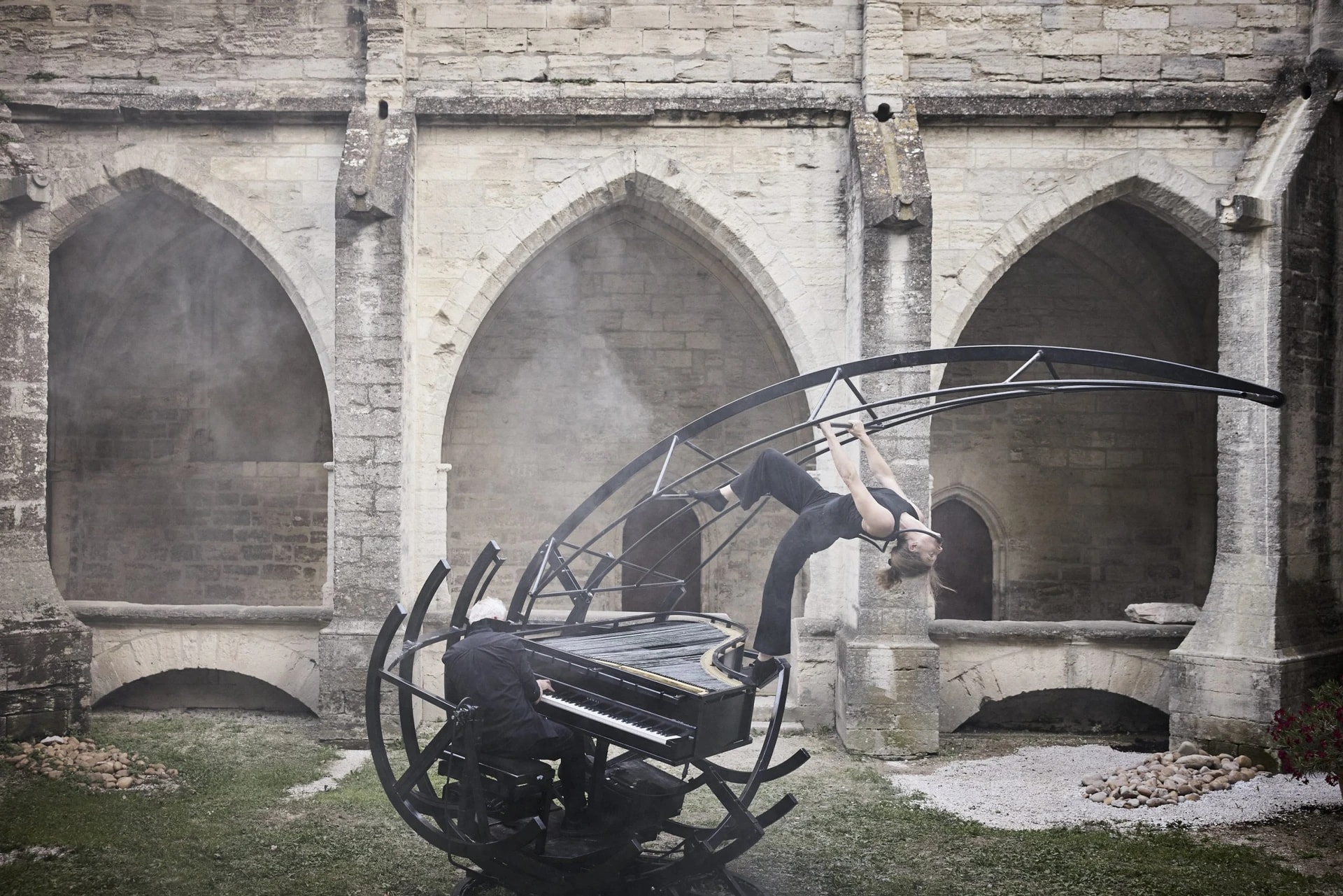
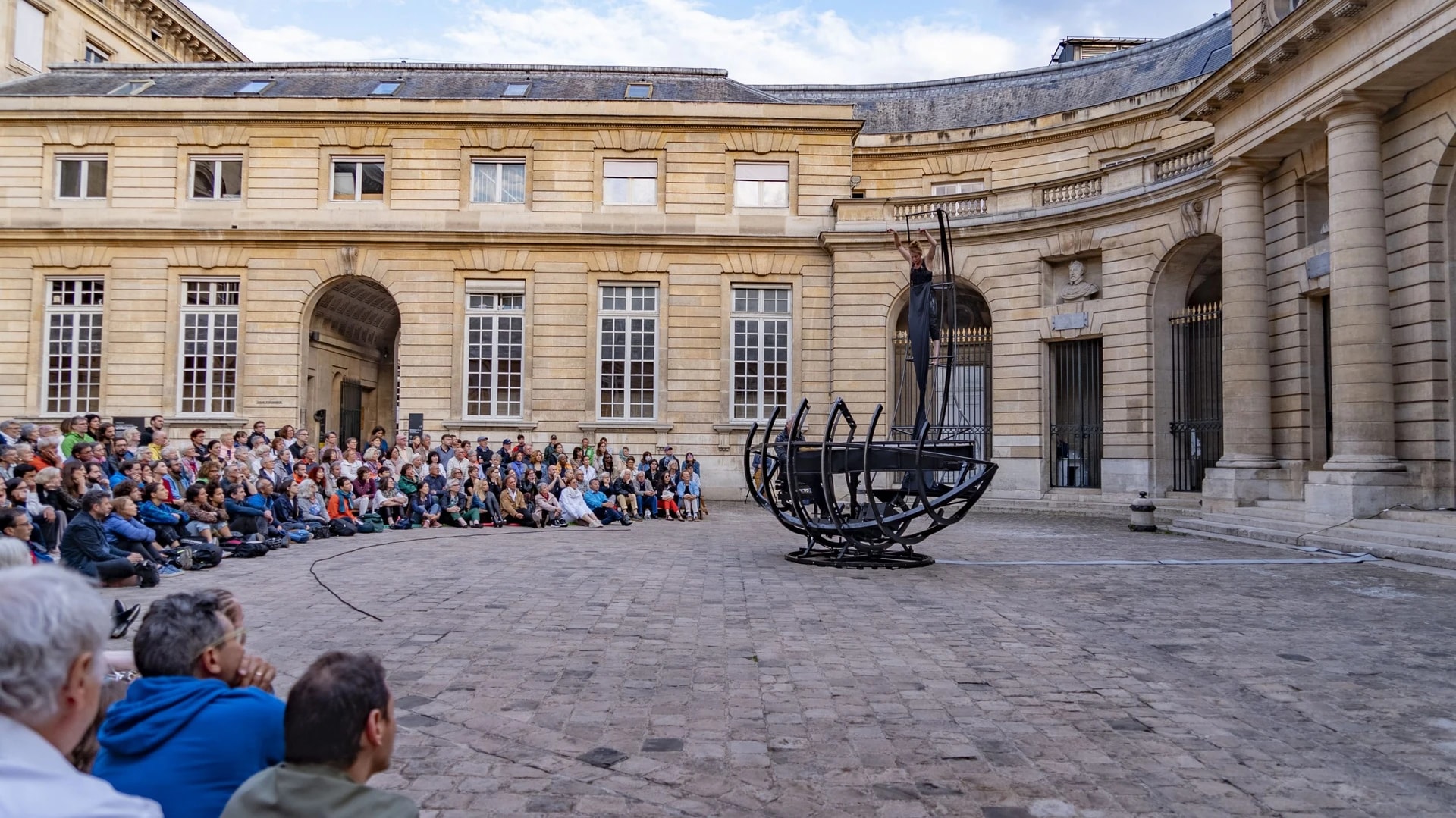
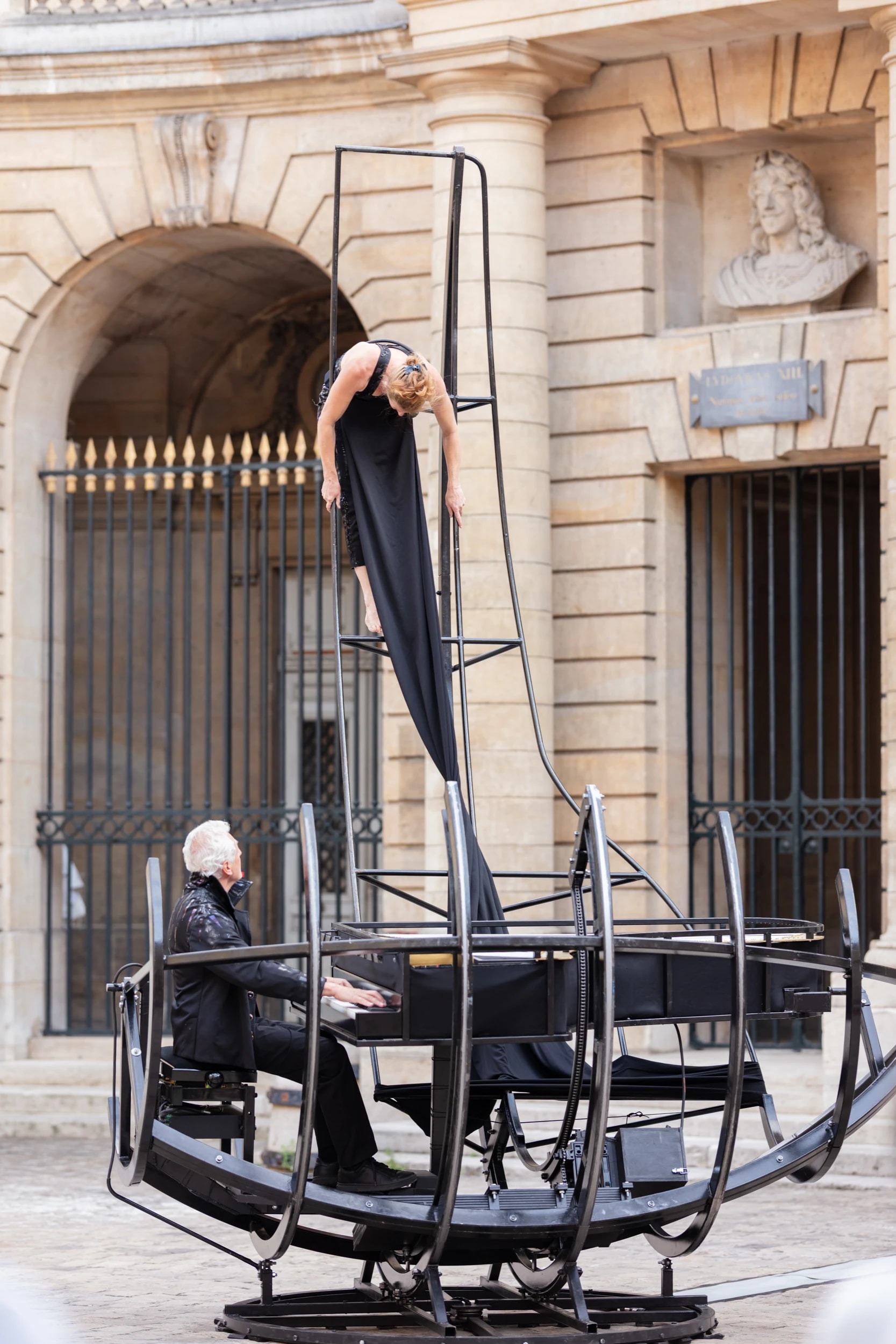
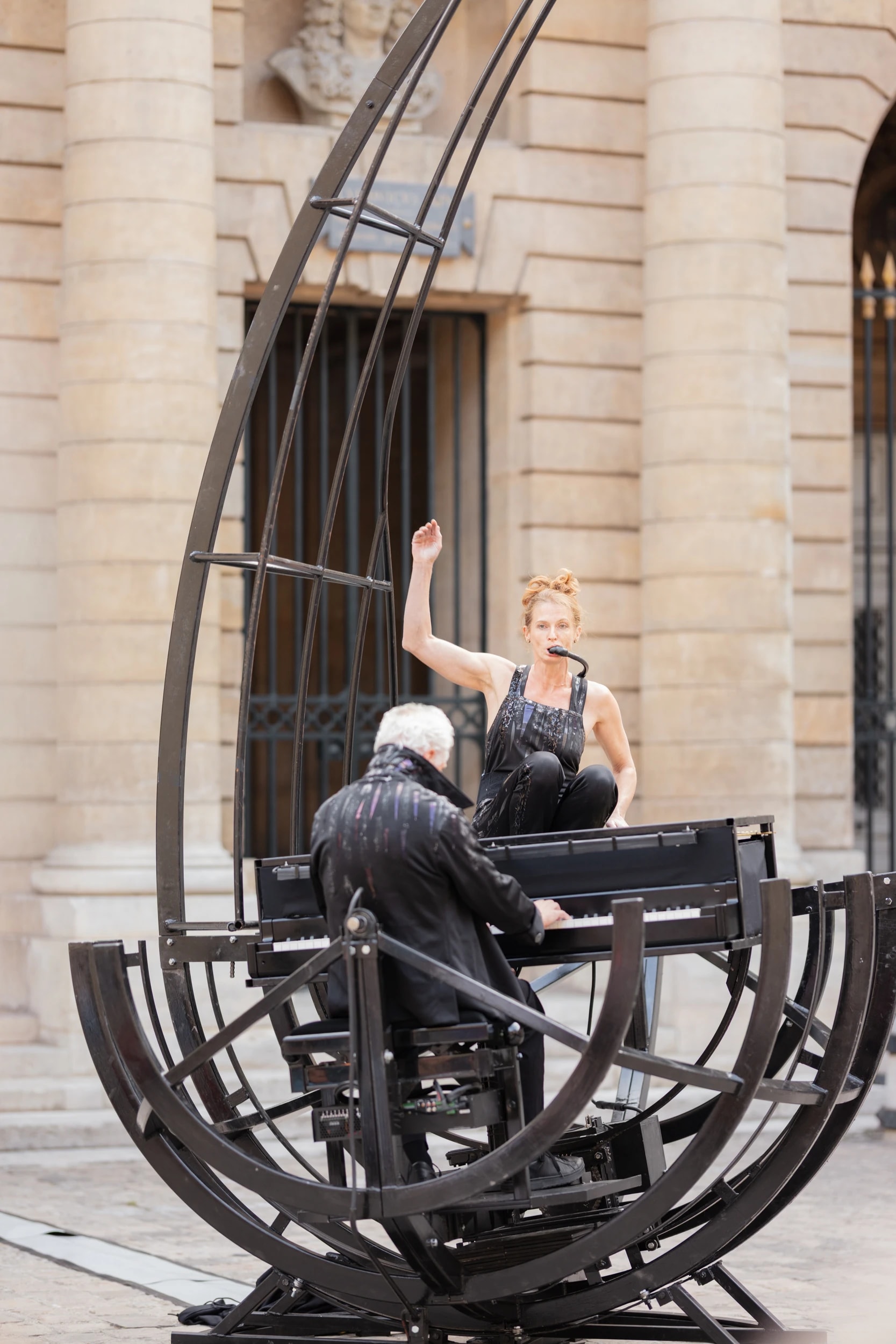
Photo credits — © Christophe Raynaud De Lage, © Andrea Fernandez